212.32.226.324 Is This a Valid IP Address?
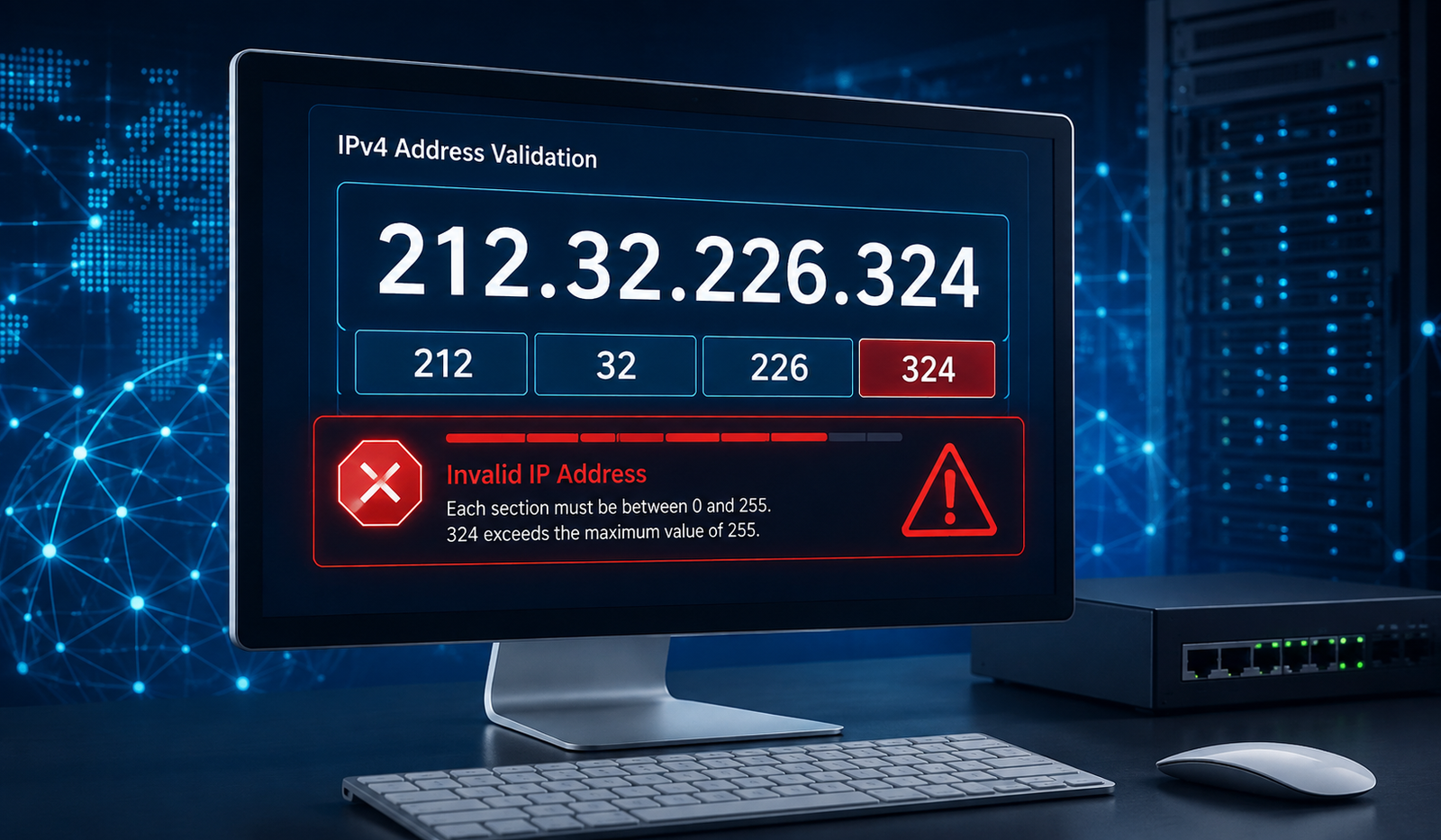
212.32.226.324 is as an invalid IPv4-style address. It resembles an IPv4 address because it has four numerical components separated by dots. Nevertheless, its final component violates the technical rules used by IPv4. However, there is an important problem hidden in the final section: 324 is outside the permitted IPv4 range.
An IPv4 address consists of four numerical sections called octets. Each octet must contain a value from 0 through 255. The first three sections of 212.32.226.324 meet that basic requirement, but the final number does not. Because 324 is greater than 255, 212.32.226.324 is not a valid IPv4 address.
That small formatting detail matters more than it might seem. IP addresses are used by computers, routers, servers, websites, security systems, and network administrators to identify devices and destinations on a network. When even one part falls outside the allowed range, networking software cannot treat the complete string as a normal IPv4 address.
What Is 212.32.226.324?
A standard IPv4 address looks something like 192.168.1.1, where every number falls between 0 and 255. The same rule applies regardless of whether the address belongs to a private network, public network, server, router, or another networked device.
In the case of 212.32.226.324, the structure initially looks correct. There are four sections, and the dots are placed in the expected positions. The issue only becomes obvious when each section is checked individually.
Why 212.32.226.324 Is Invalid
212.32.226.324 is invalid because the number 324 exceeds the maximum value of 255 allowed in an IPv4 octet. This is the key fact to remember when checking the address.
The four components are 212, 32, 226, and 324. The first number is acceptable, as are the second and third numbers. The fourth number is the problem. Since an IPv4 octet is represented using eight bits, its highest possible decimal value is 255.
This means there is no standard IPv4 address with an octet of 324. A system validating the address would normally reject the complete string rather than treating it as a usable IPv4 destination.
Understanding the Four Parts of an IPv4 Address
To understand the error, it helps to look at how IPv4 addresses work. An IPv4 address contains 32 bits divided into four groups of eight bits. Each group is commonly written as a decimal number between 0 and 255.
For example, an address such as 203.0.113.25 contains four valid octets. The value 203 is within the permitted range, 0 is valid, 113 is valid, and 25 is valid.
Now compare that structure with 212.32.226.324. The first three values fit the rules, but 324 does not. Therefore, the entire address fails IPv4 validation.
Why Is the Maximum 255?
The maximum value of an IPv4 octet comes directly from binary mathematics. Each octet contains eight bits, and each bit can have a value of either 0 or 1. Eight binary bits can represent 256 different values, starting at 0 and ending at 255.
That gives the range:
0 to 255
There is no 256, 300, or 324 within a standard eight-bit octet. This is why the final part of 212.32.226.324 immediately identifies the string as invalid.
This is also why IP address validators are useful. They do not simply count the number of sections. They check whether every individual section falls within the correct numerical range.
Could 212.32.226.324 Be a Typographical Error?
Yes, it could simply be a typing mistake. People often enter IP addresses manually, copy them from documents, or read them from screenshots and logs. A single incorrect digit can turn a valid address into an invalid one.
For example, someone might have intended to enter an address ending in a number below 256 but accidentally typed 324. Without additional information, however, there is no reliable way to determine what the intended address was.
That distinction is important. It is reasonable to say that 212.32.226.324 is invalid, but it would not be responsible to guess which valid IP address the person originally intended.
How to Check an IP Address
Checking an IPv4 address is straightforward. Start by separating the address into its four sections. Then inspect each number individually.
For 212.32.226.324, the check looks like this:
212 is valid because it falls between 0 and 255. 32 is also valid. 226 is valid as well. However, 324 is invalid because it is greater than 255.
The result is therefore clear: the complete string does not meet standard IPv4 formatting rules.
What Happens When an Invalid IP Is Entered?
The result depends on where the address is entered. A web browser, router interface, application, firewall, operating system, or network utility may respond differently, but a properly validating system should recognize that the address is not a valid IPv4 destination.
You might see an error such as an invalid address message, a parsing error, or a failure to connect. In other situations, an application may simply reject the input before attempting any network communication.
The important point is that an invalid IPv4 address cannot normally be used as a conventional destination address.
Is 212.32.226.324 a Private IP Address?
No. More importantly, 212.32.226.324 is not a valid IPv4 address at all.
Private IPv4 addresses are commonly found within specific ranges such as 10.0.0.0/8, 172.16.0.0/12, and 192.168.0.0/16. Public IPv4 addresses are outside those private ranges, although many additional rules apply when determining how an address is used.
Because the final octet in 212.32.226.324 is invalid, there is no meaningful private-versus-public classification for the complete string.
Can 212.32.226.324 Identify a Device?
Not as written. A valid IP address can sometimes identify a network interface or serve as a destination for network traffic, but 212.32.226.324 cannot function as a normal IPv4 address because its final octet is outside the permitted range.
If this value appeared in a log, message, configuration file, or article, it would be worth checking the original source. It could represent a typo, formatting mistake, copied data, or an incorrectly generated value.
Why IP Address Validation Matters
IP validation is not just a technical formality. Network systems depend on predictable addressing rules. Routers and applications need to understand whether an address represents a legitimate IPv4 destination before they can process it.
For developers, validating IP addresses can prevent bad data from entering databases or configuration files. For network administrators, validation can help identify configuration mistakes. For everyday users, understanding the basic rule can make troubleshooting much easier.
A quick range check can often explain why a connection or configuration is failing.
IPv4 and IPv6 Are Different
Another useful distinction is between IPv4 and IPv6. The address 212.32.226.324 attempts to follow the IPv4 format, which uses four decimal octets separated by dots.
IPv6 works differently. IPv6 addresses use hexadecimal groups separated by colons and support a much larger address space. An IPv6 address might look completely different from a traditional IPv4 address.
Therefore, the rules for IPv4 should not be applied blindly to IPv6. In this particular case, however, the dotted-decimal format clearly resembles IPv4, making the 0–255 octet rule the relevant check.
Could 324 Be Converted Into a Valid Octet?
No. You cannot simply treat 324 as an ordinary IPv4 octet and expect it to work. An IPv4 octet has eight bits, and its maximum decimal representation is 255.
Sometimes people encounter numbers above 255 and wonder whether the value can somehow be wrapped around or automatically converted. Standard IPv4 notation does not work that way. A value such as 324 must be corrected rather than accepted as a normal octet.
Common Mistakes When Entering IP Addresses
One of the most common IP address mistakes is entering a number above 255. Another is accidentally adding or removing a section. For instance, IPv4 normally contains four decimal components, so an address with only three or five sections needs further examination.
Extra spaces, incorrect punctuation, copied characters, and transposed digits can also cause problems. These mistakes are especially easy to make when an address is copied from a long technical document.
That is why checking every section individually is a useful habit.
How Developers Can Validate 212.32.226.324
Applications that accept IP addresses should validate input before storing or using it. A proper IPv4 validation process checks both the overall structure and the numerical range of each octet.
For 212.32.226.324, a validator would split the value into four components and examine each one. The final component, 324, would fail the range test.
Developers should generally rely on established networking libraries or carefully tested validation methods instead of creating overly simplistic checks. A basic pattern that only looks for four groups of digits could mistakenly accept an invalid address such as this one.
How Network Users Can Avoid IP Address Errors
For everyday users, the easiest approach is simple: look at all four numbers. If the address is supposed to be IPv4, each section should be between 0 and 255.
When troubleshooting, copy the address carefully rather than typing it from memory. If a system rejects it, compare it with the original source. A single incorrect digit may be responsible.
If the value came from a technical document, log, screenshot, or third-party source, verify the original context before assuming the address represents a real device.
What 212.32.226.324 Tells Us
Although the string itself does not provide a usable IPv4 destination, it does illustrate an important networking concept. An address can look correct at a glance and still fail technical validation.
That is a useful lesson for anyone working with IP addresses. Format alone is not enough. Every individual component has to follow the rules.
In this case, the number 324 is the giveaway. Once that value is spotted, the status of the address becomes clear.
Is There a Real IP Behind This Number?
There may have been a valid IP address that someone intended to write, but the available string does not tell us what it was. It would be unsafe to invent a replacement.
For example, changing 324 to 234 would produce a syntactically valid-looking address, but there is no reason to assume 234 was the intended value. The correct approach is to return to the original source and verify the number.
This is especially important when IP addresses appear in security logs, server settings, firewall rules, or technical reports.
Security Considerations When You See an Unknown IP
If you encounter an unfamiliar IP-like value in a log or security report, do not immediately assume it belongs to an attacker or a legitimate server. First confirm that the value is valid.
An invalid address such as 212.32.226.324 may indicate a data-entry problem, malformed log entry, software issue, or transcription error. Context is essential.
If a valid IP is eventually identified, additional information would be needed before drawing conclusions about its owner, location, or purpose. An IP address alone does not automatically reveal a person’s identity.
Conclusion
212.32.226.324 is an invalid IPv4 address because its final octet, 324, exceeds the maximum allowed value of 255. The first three components—212, 32, and 226—fall within the correct range, but one invalid component is enough to make the entire address unusable as a standard IPv4 address.
If you encountered this value in a document, application, network log, or configuration, the most sensible next step is to check the original source for a typing or transcription error. The key rule is easy to remember: a standard IPv4 address contains four octets, and every octet must be between 0 and 255.
Frequently Asked Questions
Is 212.32.226.324 a valid IP address?
No. 212.32.226.324 is not a valid IPv4 address because the final octet, 324, is greater than the maximum allowed value of 255.
What is wrong with 212.32.226.324?
The problem is the number 324 at the end. IPv4 octets must range from 0 to 255, so an octet containing 324 makes the complete address invalid.
Can an IPv4 address contain 324?
No. A standard IPv4 address cannot contain an octet greater than 255. Therefore, 324 cannot appear as one of the four decimal components of a conventional IPv4 address.
Does 212.32.226.324 belong to a private network?
No meaningful private-network classification can be made because the complete value is not a valid IPv4 address.
Could 212.32.226.324 be a typo?
Yes. It could be a transcription or typing error. However, without the original source, it is impossible to determine which valid IP address may have been intended.
How many parts does an IPv4 address have?
A standard IPv4 address has four numerical sections, known as octets. Each section normally contains a value from 0 through 255.
How can I fix 212.32.226.324?
Check the original source and determine what the final number was supposed to be. Do not simply replace 324 with a random number. The corrected address should have four valid octets, each between 0 and 255.
Read also: NL49DEUT7370000143 IBAN, Bank, Payments, and Key Details