
111.90.150.2044 Understanding This Unusual IP Address
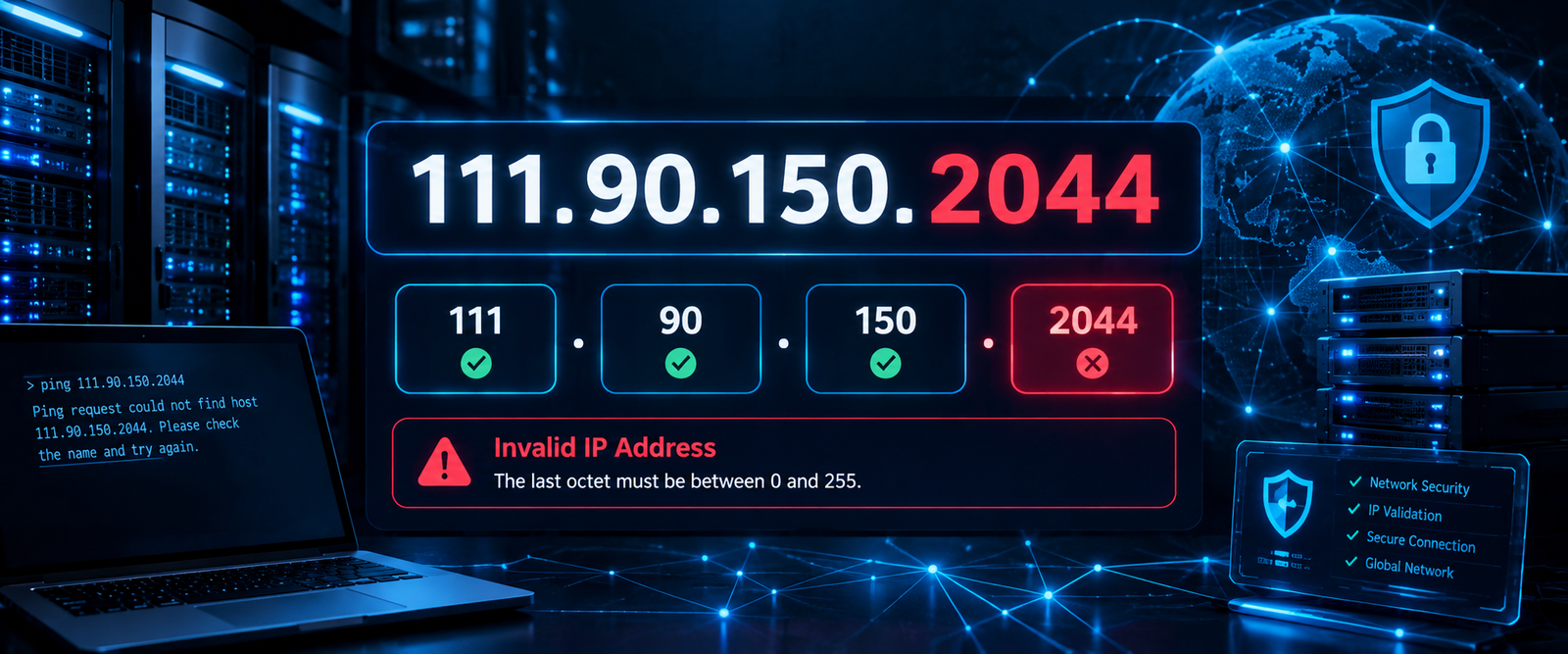
The string 111.90.150.2044 resembles an IPv4 address, but it does not meet the technical rules required for one. An IPv4 address contains four numerical sections called octets, and each octet can range from 0 through 255. In this case, the sections are 111, 90, 150, and 2044. The first three values fall within the accepted range, while 2044 does not. Because of that final number, the complete string cannot function as a conventional IPv4 address.
Why 111.90.150.2044 Is Invalid
The simplest way to understand the problem is to look at the range allowed by IPv4. Every octet is represented by eight bits, which creates 256 possible values starting at 0 and ending at 255. Therefore, values such as 10, 100, 192, and 255 are possible, but a value such as 2044 cannot appear as one octet. Since 2044 is much greater than 255, 111.90.150.2044 fails the basic IPv4 formatting requirement.
Could 2044 Be a Typographical Error?
Yes, and this is probably one of the first things worth checking. People frequently copy numbers incorrectly, add an extra digit, or combine an IP address with another number. If you encountered 111.90.150.2044 in a log, message, website, application, or technical document, check the original source carefully. It may have been intended to say 111.90.150.204, 111.90.150.24, or another similar address. One extra digit can completely change whether a string is technically valid.
How IPv4 Addresses Work
IPv4, short for Internet Protocol version 4, is one of the main systems used to identify devices and network interfaces on computer networks. A traditional IPv4 address contains 32 bits divided into four eight-bit sections. Those sections are normally written as decimal numbers separated by periods, creating a format such as 192.168.1.10. Each section can have a value from 0 to 255. This structure is why an address such as 111.90.150.2044 cannot be accepted as a standard IPv4 address.
What Does Each Part of an IP Address Mean?
It is tempting to assume that each number in an IP address has a simple geographic meaning, but that is not how IPv4 addresses work. The four octets collectively represent a 32-bit network address, and their interpretation depends on network configuration and addressing systems. Some addresses are publicly routable, while others are reserved for private networks or special purposes. Consequently, simply looking at a number does not automatically tell you the exact person, house, or device associated with it.
Public IP Address vs Private IP Address
One useful distinction when researching an IP address is whether it is public or private. A public IP address can generally be associated with an internet connection and may be visible to websites or online services. Private IP addresses are used inside local networks and commonly include ranges such as 192.168.0.0/16, 10.0.0.0/8, and 172.16.0.0/12. The string 111.90.150.2044 does not qualify as either a normal public or private IPv4 address because it is invalid before that classification even becomes relevant.
Can 111.90.150.2044 Identify a Person?
No, not as written. Since the string is not a valid IPv4 address, it cannot reliably be used to identify a particular internet connection or person. Even with a valid public IP address, however, an IP generally does not reveal someone’s exact identity by itself. Internet service providers maintain customer and connection records, but those records are not normally available to ordinary users simply because they know an IP address.
Can an Invalid IP Address Be Dangerous?
The number itself is not dangerous simply because it looks unusual. An invalid IPv4 address cannot normally be used as a standard destination address on the internet. The more important question is where you found it. If the number appeared in a suspicious email, strange browser notification, unfamiliar application, or security alert, investigate the surrounding information rather than assuming the number itself proves malicious activity. Sometimes malformed technical information is simply the result of a typo or poor formatting.
What If You Received 111.90.150.2044 in an Email?
If someone sent you 111.90.150.2044 in an email or message, avoid jumping to conclusions. First, compare it with the original source and check whether one of the digits may have been entered incorrectly. If the message is asking you to install software, open an unknown file, provide a password, or send money, the request deserves more attention than the IP-looking string itself. Suspicious messages should be evaluated based on their complete context rather than a single number.
What If You Saw It in a Website Log?
Website and server logs can contain unusual strings for many reasons. A malformed address may come from application errors, incorrectly parsed data, automated requests, copied information, or a logging problem. If 111.90.150.2044 appears in a log, check the timestamp, request path, user-agent information, surrounding entries, and application configuration. You should also verify whether the logging system stored the value exactly as received or transformed it during processing.
How to Check Whether an IP Address Is Valid
Checking an IPv4 address is straightforward. Separate the address at every period and count the four sections. Each section must be a decimal number between 0 and 255. For example, 111.90.150.204 passes the basic range test because all four values are within the allowed limits. By contrast, 111.90.150.2044 fails because the final value is 2044. This simple check can immediately distinguish a correctly formatted IPv4 address from an invalid one.
What If You Meant 111.90.150.204?
If your intended address was 111.90.150.204, that is a properly formatted IPv4 address. It can then be investigated using legitimate IP lookup or network diagnostic tools to determine information such as its registered network or approximate geographic association. Keep in mind that IP geolocation is not an exact method for locating an individual. Results can point to an ISP, organization, city, or data center rather than the physical location of a particular person.
Does an IP Address Reveal an Exact Location?
Usually, no. IP-based geolocation can provide an approximate location, but it should not be treated like GPS. A public IP may be registered to an internet provider, hosting company, business, VPN provider, or data center. Mobile networks can make the situation even more complicated because users may share infrastructure and addresses. Therefore, even a valid IP address should not be interpreted as proof of someone’s exact street address.
Why Do IP Addresses Sometimes Look Strange?
Network data is not always presented perfectly. An address may be copied from a browser message, converted incorrectly by software, displayed alongside a port number, or mixed with another identifier. Some applications also produce malformed values because of programming or validation mistakes. That means a strange-looking string does not automatically indicate hacking, tracking, or fraud. Understanding how the data was generated is often more useful than looking at the number in isolation.
IP Address vs Port Number
Another common source of confusion is the difference between an IP address and a port number. An IP identifies a network interface or destination, while a port helps identify a particular service or application endpoint. You might see information represented in a form such as 111.90.150.204:8080, where 8080 is a port rather than part of the IPv4 address. If a number was copied from network software, check whether the final value was actually a port, identifier, or other field rather than an additional IP octet.
Could It Be an IPv6 Address?
No. IPv6 uses a completely different format. Instead of four decimal octets separated by periods, IPv6 addresses normally contain groups of hexadecimal characters separated by colons, such as 2001:db8::1. Therefore, 111.90.150.2044 does not become valid simply by interpreting it as IPv6. It does not follow the standard syntax of either a conventional IPv4 or IPv6 address.
How to Handle an Unknown IP-Like Number
If you encounter an unfamiliar IP-like value, start with basic validation. Check the number carefully, determine where it appeared, and identify what application or service generated it. If it is a valid public IP, you can research its network ownership through reputable IP information services. If it is invalid, focus on finding the original source and determining whether the number was entered or displayed incorrectly. This approach is much more reliable than assuming an unfamiliar number is automatically suspicious.
When Should You Be Concerned?
An invalid IP address alone is not a strong warning sign. Concern becomes more reasonable when the number appears alongside other suspicious behavior, such as unexpected login alerts, unauthorized account activity, malicious downloads, repeated connection attempts, or requests for sensitive information. In those situations, review security logs, change compromised passwords, enable multi-factor authentication, and scan affected systems where appropriate. The surrounding evidence matters far more than the unusual number by itself.
Conclusion
The most important thing to know about 111.90.150.2044 is simple: it is not a valid IPv4 address. Although it looks similar to a conventional IP address, the final octet, 2044, is outside the permitted 0–255 range. That usually points toward a typing mistake, formatting issue, copied value, or another piece of network information being incorrectly interpreted as an IP address. If you encountered this number in a technical log, email, website, or security notification, look at the surrounding context and verify the original value. And if the intended address was 111.90.150.204, that is a different matter because it follows the basic IPv4 structure and can be examined normally.
Frequently Asked Questions About 111.90.150.2044
Is 111.90.150.2044 a valid IP address?
No. 111.90.150.2044 is not a valid standard IPv4 address because an IPv4 octet cannot be greater than 255. The final section, 2044, exceeds that limit.
What is wrong with 111.90.150.2044?
The problem is the fourth section. IPv4 addresses contain four octets, and each octet must contain a value from 0 to 255. Since 2044 is outside that range, the address is invalid.
Could 111.90.150.2044 be a typo?
Yes. It may have been entered incorrectly or copied with an additional digit. If you saw it somewhere, compare it with the original source to determine whether a valid address such as 111.90.150.204 was intended.
Can I locate someone using 111.90.150.2044?
No. Because the string is not a valid IPv4 address, it cannot be reliably used for IP-based location. Even valid public IP addresses generally provide approximate network or geographic information rather than an exact person’s location.
Is 111.90.150.2044 a scam IP address?
There is not enough information to call it a scam address. In fact, as written, it is not a valid IPv4 address at all. If it appeared in a suspicious message, investigate the message, links, attachments, and other technical details rather than relying on this number alone.
What should I do if I meant 111.90.150.204?
If 111.90.150.204 is the number you intended, you can perform a legitimate IP lookup to research its network and approximate registration information. Remember that IP lookup results do not necessarily identify an individual or exact physical location.
How many numbers can an IPv4 address contain?
A standard IPv4 address contains four numerical sections, separated by periods. Each section can range from 0 to 255. For example, 192.168.1.1 follows the basic IPv4 format, while an address containing an octet such as 2044 does not.
Read also: Forgeryube Meaning, Digital Security, and Online Risks


One thought on “111.90.150.2044 Understanding This Unusual IP Address”