
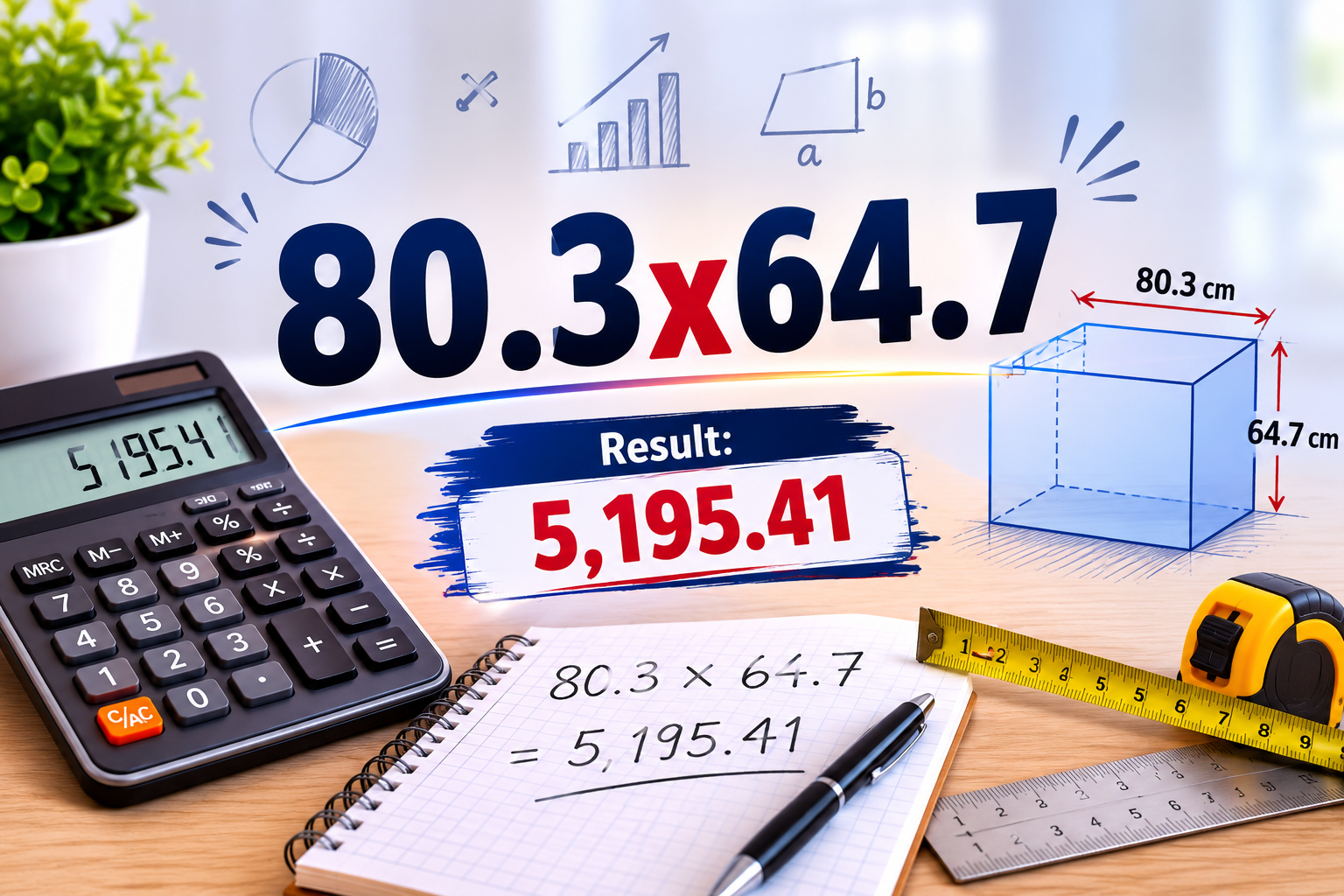
80.3×64.7 Meaning, Calculation & Practical Uses
80.3 × 64.7 Calculation
When 80.3×64.7 is intended as a multiplication problem, the answer is 5,195.41. One useful way to understand the calculation is to temporarily remove the decimal points and multiply 803 by 647. After completing the multiplication, the decimal places are restored because 80.3 has one decimal place and 64.7 also has one decimal place, giving two decimal places in the final answer. This produces 5,195.41. Another way to check the result is to estimate first. Since 80.3 is close to 80 and 64.7 is close to 65, the approximate calculation is 80 × 65 = 5,200. The exact result of 5,195.41 is therefore reasonable and passes a simple estimation check.
How to Multiply 80.3 by 64.7
Multiplying these numbers manually is easier when you treat the decimals as whole numbers at first. Start with 803 × 647. The multiplication gives 519,541. Because the original numbers each contain one digit after the decimal point, there are two decimal places to restore in the answer. Moving the decimal point two places from the right gives 5,195.41. This method is useful because it reduces the chance of getting confused by decimal alignment. It is also a good technique for students, shoppers checking measurements, professionals reviewing calculations, or anyone who wants to verify an answer without relying entirely on a calculator.
Why Decimal Multiplication Can Be Confusing
Decimal multiplication often causes mistakes because people sometimes add or move decimal points incorrectly. A common error is to treat 80.3 × 64.7 as though the decimal positions do not matter, which can produce an answer that is ten or one hundred times too large or too small. The easiest protection is to count decimal places before finalizing the answer. In this example, there is one decimal place in each factor, so the final answer should contain two decimal places. Estimation is another excellent safeguard. Because 80.3 × 64.7 should be slightly below 80 × 65, an answer such as 519.541 or 51,954.1 should immediately raise suspicion. Good calculation is not only about getting a number; it is also about checking whether that number makes sense.
Is 80.3×64.7 a Measurement?
It can be. If you found 80.3×64.7 on a product listing, blueprint, furniture specification, packaging label, image specification, or technical document, the “x” may separate two measurements rather than indicate multiplication. For example, 80.3 × 64.7 cm could describe the dimensions of a panel, mat, tabletop, poster, frame, or another rectangular object. In that situation, the numbers do not normally mean that the item has a single measurement of 5,195.41. Instead, they describe two separate sides. The unit is essential because 80.3 × 64.7 inches is dramatically different from 80.3 × 64.7 millimeters. Always check whether the source includes cm, mm, inches, feet, pixels, or another measurement unit before interpreting the expression.
Understanding 80.3×64.7 as Dimensions
When two numbers are written with an “x” between them, they are frequently presented as dimensions. A listing might use a format such as width × height or length × width. If that is the case, 80.3 × 64.7 describes a rectangular space with two sides measuring 80.3 and 64.7 units respectively. The order can matter because some industries consistently list dimensions as length × width, width × height, or width × depth. Digital graphics may use width × height, while furniture specifications may use length × width × height. Therefore, the numbers alone do not reveal which side comes first. You need the source’s labeling or measurement convention to understand the dimensions correctly.
Area of an 80.3 × 64.7 Rectangle
If 80.3 and 64.7 represent the length and width of a rectangle using the same unit, their product gives the area. In this case, 80.3 × 64.7 = 5,195.41 square units. If the measurements are centimeters, the area would be 5,195.41 square centimeters. If they are meters, it would be 5,195.41 square meters. The phrase “square units” is important because multiplying two lengths changes the type of measurement. A length multiplied by another length becomes an area. This distinction is useful in flooring, construction, landscaping, fabric planning, printing, interior design, and many other situations where people need to estimate how much surface a particular rectangular space covers.
80.3×64.7 in Everyday Situations
You might encounter a number pair like 80.3×64.7 in more places than you expect. Online stores commonly display product dimensions, while manufacturers use measurements in specification sheets. Graphic designers may work with canvas sizes, and photographers may deal with image dimensions or print sizes. Engineers and technicians regularly encounter decimal measurements in drawings and equipment documentation. Even ordinary household purchases can involve dimensions when comparing furniture, carpets, curtains, storage containers, or wall decorations. The important thing is not to assume that every “x” means multiplication. Look at the surrounding text. A calculator problem usually expects a numerical answer, while a product specification usually expects you to understand the physical or digital size.
Why Units Matter for 80.3×64.7
A measurement without a unit is incomplete. Consider 80.3 × 64.7 by itself: it tells you the numerical dimensions but not whether those dimensions are centimeters, inches, millimeters, meters, pixels, or another unit. That difference can completely change the practical meaning. An object measuring 80.3 × 64.7 millimeters is relatively small, while one measuring 80.3 × 64.7 meters would be enormous. The same principle applies to digital media. A graphic measuring 80.3 × 64.7 pixels would be tiny compared with one measured in centimeters for printing. Whenever you see this expression outside a pure math problem, identify the unit before making decisions based on the numbers.
80.3×64.7 for Digital Design
In digital design, numbers separated by an “x” often describe a canvas or image size. However, designers normally work with pixels, inches, millimeters, points, or other clearly defined units. If 80.3×64.7 appears in a design application, the decimal values could represent a physical print dimension or another setting rather than simple pixel dimensions. The context of the software is therefore important. For online graphics, dimensions are often expressed as whole pixel values such as 1200 × 628, while print specifications may use decimal measurements. If you are preparing an image for publication, printing, or advertising, checking both the dimensions and the required unit helps prevent an otherwise good design from being exported at the wrong size.
80.3×64.7 in Construction and Home Projects
Measurements with decimal values are common in construction, renovation, woodworking, and home improvement. A person measuring a wall, countertop, board, tile area, or furniture space might record dimensions such as 80.3 × 64.7. In these situations, accuracy matters because even a small difference can affect whether an item fits properly. If the numbers represent centimeters, the corresponding rectangular area is 5,195.41 square centimeters. If they represent inches, the numerical area is the same but the unit becomes square inches. Before buying materials or cutting anything, it is wise to confirm the measurement system and measure the space more than once. A calculator can confirm arithmetic, but it cannot correct an inaccurate measurement.
Common Mistakes When Reading 80.3×64.7
One of the biggest mistakes is assuming that 80.3×64.7 has only one possible meaning. It may be a multiplication expression, two dimensions, or part of a technical identifier depending on the source. Another mistake is ignoring units. A third is assuming that the first number must always represent width and the second must always represent height. Different industries use different conventions. People also sometimes calculate the product when they actually need to preserve the dimensions as separate values. If a product says 80.3 × 64.7 cm, for example, you generally should not replace that information with “5,195.41 cm.” That would change the meaning and the unit.
How to Verify 80.3×64.7
If you are unsure what 80.3×64.7 means, start by examining the original source. Look for labels such as width, height, length, area, dimensions, size, or quantity. Next, check for a unit of measurement. If the expression appears in a mathematical question, the “x” almost certainly indicates multiplication. If it appears beside a product photo or specification table, dimensions are more likely. You can then calculate the product separately if you need the area. Finally, compare the result with a rough estimate. These simple checks can prevent mistakes and are especially useful when the information will be used for purchasing, construction, design, or another practical task.
Is 5,195.41 the Correct Answer?
Yes, if 80.3×64.7 means multiplication, the correct result is 5,195.41. The calculation can be verified through estimation because 80.3 is slightly greater than 80 and 64.7 is slightly less than 65. Their product should therefore be close to 5,200. The exact value, 5,195.41, fits that expectation. If the numbers represent dimensions, however, 5,195.41 should be interpreted as the area only when both measurements use the same unit and form the sides of a rectangle. In that context, the correct description would be 5,195.41 square units, not simply 5,195.41 units.
Why Context Is More Important Than the Numbers
Numbers can look precise while still being ambiguous. 80.3×64.7 is a good example. Mathematically, the expression has a clear result. In a measurement context, however, the same characters may communicate size rather than multiplication. This is why good technical writing always provides context. A product page should ideally identify the dimensions and units. A mathematical problem should make the operation clear. A design specification should state whether values are pixels or physical measurements. When context is missing, the best approach is to avoid making assumptions and determine what the source intended.
A Simple Way to Remember the Calculation
If you only need to remember the mathematical result, keep this simple: 80.3 × 64.7 = 5,195.41. You can also remember the estimation method. Round 80.3 to 80 and 64.7 to 65, then calculate 80 × 65 = 5,200. The exact answer should be close to that figure, which it is. This habit of estimating before accepting a calculator result is useful far beyond this particular calculation. It gives you a quick way to spot misplaced decimal points, typing mistakes, and unrealistic answers.
Conclusion
80.3×64.7 is a small expression with more than one possible interpretation. When used as multiplication, it equals 5,195.41. When used as dimensions, it describes two measurements whose practical meaning depends on the unit and context. That distinction is worth remembering because numbers are only useful when we understand what they represent. Whether you encountered this expression in a calculation, product specification, design project, measurement sheet, or everyday situation, checking the surrounding information is the best way to interpret it correctly. When in doubt, identify the unit, determine what the “x” represents, and then calculate the result if an area or product is actually required.
Frequently Asked Questions About 80.3×64.7
What is 80.3×64.7?
If the “x” represents multiplication, 80.3 × 64.7 equals 5,195.41. If the expression represents dimensions, it means two separate measurements of 80.3 and 64.7 units, and the exact interpretation depends on the context and unit.
What is 80.3 multiplied by 64.7?
80.3 multiplied by 64.7 is 5,195.41. Both numbers contain one decimal place, so the final multiplication result contains two decimal places.
Can 80.3×64.7 represent dimensions?
Yes. An expression such as 80.3 × 64.7 cm can represent the dimensions of a rectangular object or surface. The numbers describe two sides rather than a multiplication answer.
What is the area of 80.3×64.7?
If 80.3 and 64.7 are the sides of a rectangle measured in the same unit, the area is 5,195.41 square units. For centimeters, that becomes 5,195.41 square centimeters.
Does the x in 80.3×64.7 always mean multiplication?
No. The “x” commonly represents multiplication, but it is also widely used to separate dimensions. The surrounding information determines which meaning is intended.
Why are the units important?
Units tell you what the numbers actually represent. For example, 80.3 × 64.7 centimeters and 80.3 × 64.7 inches describe very different physical sizes, even though the numerical values are identical.
How can I check the answer quickly?
Use estimation. Since 80.3 is close to 80 and 64.7 is close to 65, calculate 80 × 65, which equals 5,200. The exact answer, 5,195.41, is close enough to confirm that the calculation is reasonable.
Read also: missleahadamsx TikTok Username, Profile & Identity Guide