
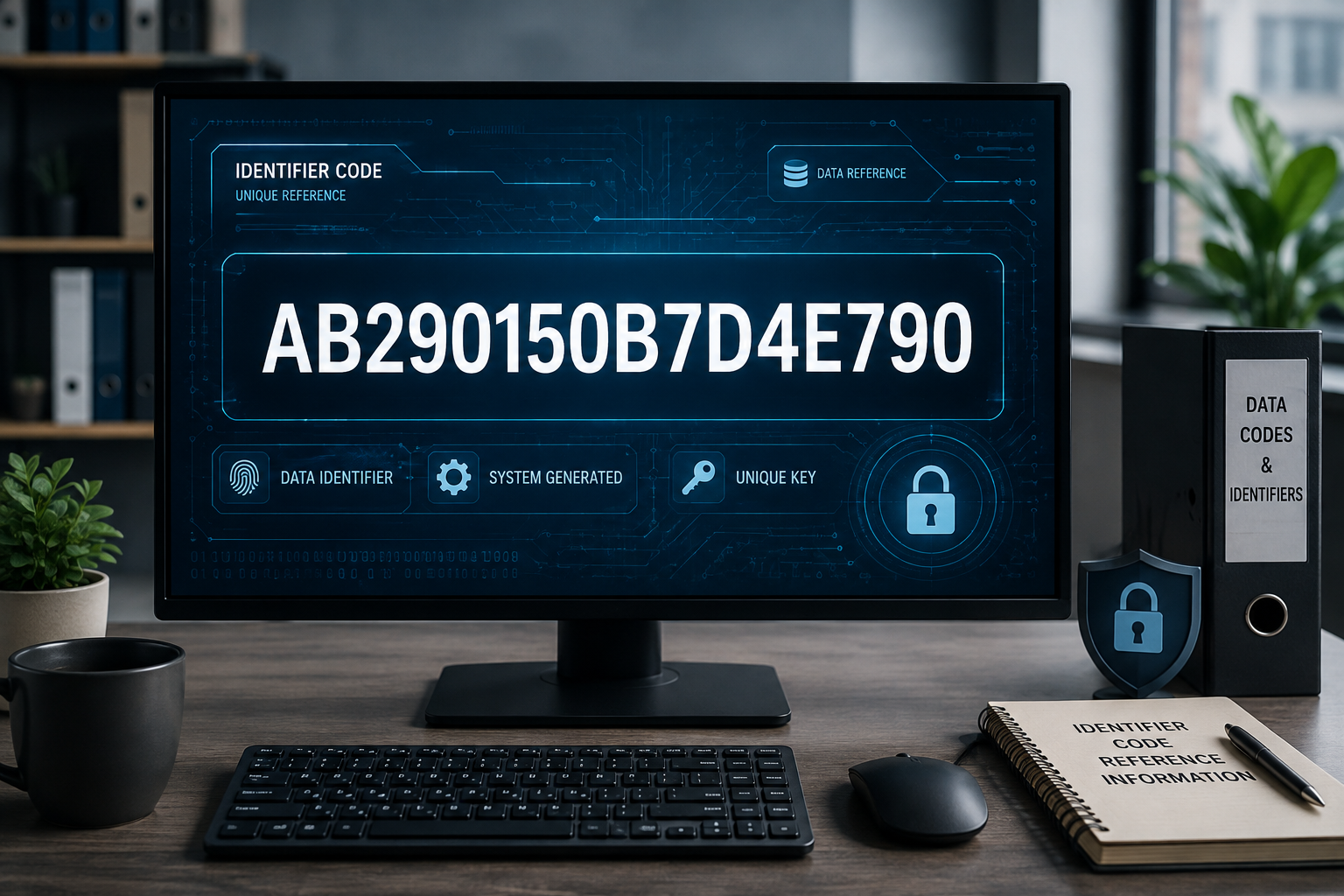
AB290150B7D4E790 Meaning, Search Intent, and Context
AB290150B7D4E790 appears to be an alphanumeric identifier consisting of uppercase letters and numbers. It is not formatted like a conventional telephone number, common date, standard word, or familiar internet domain. Its structure makes it more likely to be a machine-generated or system-specific reference than an ordinary phrase.
The important distinction is that an alphanumeric string can have meaning without having a universal meaning. For example, a website may use a long code to identify a database record, while another service could generate a completely different code using the same general format. Therefore, the surrounding context is often more valuable than the characters themselves.
Is AB290150B7D4E790 a Product Code?
It is possible that a string such as AB290150B7D4E790 could function as a product, inventory, order, catalog, or internal reference code. Businesses frequently use combinations of letters and numbers to distinguish individual records or items.
However, there is no reliable basis for saying that this particular string is definitely a product code. A genuine product identifier normally has some connection to a manufacturer, retailer, catalog, barcode system, model number, or inventory platform.
If you found the code on packaging, an invoice, an online marketplace, or a product page, that surrounding information would be the strongest clue. Without that context, assigning it to a specific product would simply be speculation.
Why Do Websites Use Codes Like AB290150B7D4E790?
Websites and applications use identifiers for many ordinary technical reasons. A database might assign a unique value to a user record, article, transaction, uploaded file, session, or other digital object.
Long identifiers are especially useful when a system needs values that are unlikely to collide with one another. Instead of calling something simply “item 25,” a platform may generate a much longer string that uniquely identifies the record.
This means seeing a strange code does not automatically indicate anything suspicious. In many cases, it is simply a technical reference that users were never expected to interpret manually.
Could AB290150B7D4E790 Be a Tracking Code?
Another possibility is that the string represents a tracking or reference value. Online services sometimes attach unique identifiers to links, transactions, campaigns, customer requests, or digital sessions.
A tracking identifier normally appears alongside other information that explains its purpose. For example, an email campaign may contain unique parameters, while a shipping service may provide a shipment reference connected to a carrier.
Still, AB290150B7D4E790 alone cannot be confirmed as a tracking code. The safest approach is to examine the page, message, email, receipt, or application where it appeared rather than assuming what the string means.
Is AB290150B7D4E790 a Password or Security Token?
The format could resemble certain automatically generated security values, but that does not mean it is a password, authentication token, API key, or access credential.
Security-related values can look random because randomness makes them harder to guess. However, many ordinary identifiers also look random. Appearance alone is not enough to distinguish between them.
If you discovered this string inside an account, email, application, or developer dashboard and it appears to grant access to something, avoid publishing it publicly. Treat unknown credentials and access tokens as potentially sensitive until their purpose has been established.
Understanding the Structure of AB290150B7D4E790
Looking at the structure can provide clues, although it cannot reveal a definitive meaning. The string combines alphabetic characters with digits and uses uppercase formatting.
That pattern is common in automatically generated identifiers because computers can easily create combinations from a defined character set. Systems may also use uppercase characters to make codes easier to standardize across databases and applications.
The lack of separators is another interesting feature. Codes designed for human use sometimes contain hyphens or spaces to make them easier to read. A continuous string may instead suggest that the identifier was designed primarily for computer processing.
Why the Exact Context Matters
Imagine finding AB290150B7D4E790 on a delivery receipt. You might reasonably suspect that it is related to the shipment. If you found the same-looking string inside a software application, however, it might be a database identifier.
The characters have not changed, but the context has.
This is why responsible identification matters. A code should be interpreted according to the system that produced it. Search engines can sometimes reveal where an unusual string appears, but even matching results do not automatically prove what the identifier means.
How to Research AB290150B7D4E790
The first useful step is to search the exact string rather than variations of it. Put AB290150B7D4E790 in quotation marks when searching because this tells a search engine that you are looking for the precise sequence.
Next, examine the pages where the exact string appears. Look for repeated patterns. If several pages use the code in connection with the same company, platform, document type, or product, that can provide a useful clue.
You should also consider where you originally encountered it. An email, receipt, website URL, software interface, package, social media page, or downloadable document can each point toward a different explanation.
What If Search Results Are Confusing?
Sometimes unusual identifiers appear across multiple low-quality pages without any clear explanation. This can happen when websites automatically generate pages, copy content, publish database entries, or create search-oriented pages around obscure strings.
In that situation, quantity does not equal credibility. Seeing the same code on several websites does not necessarily establish its meaning, especially if those websites repeat the same information without identifying an original source.
A better approach is to look for first-party evidence. If the identifier supposedly belongs to a company or service, information from that organization’s official documentation or customer support channels is more useful than anonymous pages repeating the code.
Could AB290150B7D4E790 Be Random?
Yes. That is one of the possibilities worth considering.
Modern websites generate enormous numbers of random-looking strings for internal operations. Some have no human-readable meaning at all. They simply need to be unique.
This is easy to overlook because humans naturally search for patterns. When we see letters followed by numbers and more letters, we instinctively assume there must be a hidden message. In reality, the string may simply be an automatically generated identifier.
AB290150B7D4E790 and SEO Search Intent
From an SEO perspective, an unusual keyword such as AB290150B7D4E790 creates a very different search-intent challenge from a conventional topic.
Someone searching for this exact string is likely trying to identify it, understand where it came from, verify whether it is legitimate, or find information connected to a particular website or service.
That means a useful article should not pretend to know an answer that cannot be verified. Instead, it should explain the possible categories, describe how identifiers work, and help readers determine the meaning from context.
That approach is more useful to readers and creates stronger trust than filling a page with unsupported claims.
What Information Should You Look For?
When trying to identify an unfamiliar code, the surrounding information can be extremely valuable. Pay attention to nearby words, labels, URLs, account screens, product descriptions, order information, document headings, and messages.
For example, if the code appears directly next to the words “Order ID,” its role becomes much clearer. If it appears beside “Reference,” it may be a customer-service or transaction reference. If it appears in a software database, it may simply be an internal record identifier.
The code itself is only one piece of the puzzle.
Is It Safe to Share AB290150B7D4E790?
That depends on what the code represents. If it is simply a public article identifier, sharing it may be harmless. If it is connected to an account, transaction, private document, invitation, or authentication system, publishing it could create unnecessary risk.
A good rule is simple: do not publicly share an unknown code until you know what it does.
This is particularly important when an unfamiliar string appears in an email or message asking you to click a link, provide information, or sign in. The identifier may be harmless, but the surrounding request could still be part of a phishing attempt.
How to Tell Whether a Code Looks Suspicious
The appearance of AB290150B7D4E790 is not enough to label it suspicious. Instead, consider its behavior and context.
A code deserves closer attention if it arrives unexpectedly, appears in a message demanding urgent action, is associated with an unfamiliar website, or is presented alongside requests for passwords, payment information, or personal details.
On the other hand, a code displayed inside a legitimate account dashboard, invoice, order history, or software interface may simply be an ordinary technical identifier.
Context should guide the investigation.
Common Mistakes When Searching Unknown Codes
One common mistake is assuming that the first search result provides the official meaning. Search results can contain automatically generated pages, copied information, outdated material, or unrelated matches.
Another mistake is changing the characters while searching. With identifiers, one incorrect letter or digit can lead to an entirely different result. A character such as “0” may also be confused with “O,” while “1” and “I” can sometimes look similar.
The best approach is to copy the identifier exactly and compare it with the original source before drawing conclusions.
What AB290150B7D4E790 Does Not Tell You
The string itself does not reveal a confirmed owner, purpose, location, date, product, or person. Those details require independent evidence.
This is an important point for anyone researching obscure search terms. A plausible explanation is not the same as a verified explanation. Good research separates what can be observed from what can actually be established.
For AB290150B7D4E790, the observable fact is that it is an alphanumeric sequence. Its exact purpose depends on the system or source in which it appears.
A Practical Way to Investigate It
Start with the original source. If you saw the code on a website, return to that page and inspect the surrounding content. If it came from an email, examine the sender and the context. If it appeared on a receipt, check the labels around it.
Then search the exact string. Compare multiple results rather than relying on one page. Look for official documentation, consistent terminology, and trustworthy sources that explain the identifier.
Finally, avoid entering the code into random websites simply because they claim to provide a lookup service. Unknown identifiers can sometimes be connected to private systems, and unnecessary third-party submissions can expose information.
Why Accurate Information Matters for Obscure Keywords
When a keyword has little publicly documented information, there is a temptation to create a confident explanation simply to satisfy the search query. That approach may produce readable content, but it does not produce trustworthy content.
A better article acknowledges uncertainty where uncertainty exists. It explains the reasonable possibilities without presenting speculation as fact.
For readers searching AB290150B7D4E790, that distinction matters. They are probably looking for clarity, not an invented definition.
Conclusion
AB290150B7D4E790 appears to be an alphanumeric identifier whose exact meaning cannot be reliably determined from the string alone. It could potentially be an internal reference, database identifier, product-related code, tracking value, or another system-generated string.
The most reliable way to identify it is to investigate the source where it appeared. Look at the surrounding labels, website, document, message, or platform, and then verify the information against a trustworthy source.
If you are researching this keyword for SEO, the strongest content strategy is to answer the reader’s real question honestly: explain what can be established, discuss the likely possibilities, and avoid claiming a specific meaning without evidence. That makes the page more useful and gives readers a reason to trust it.
FAQs About AB290150B7D4E790
What is AB290150B7D4E790?
AB290150B7D4E790 is an alphanumeric string that appears to function like a code or identifier. Its exact purpose cannot be confirmed from the characters alone and depends on where the string originated.
Is AB290150B7D4E790 a product number?
It could potentially be used as a product or inventory identifier, but there is not enough information in the string itself to confirm that. The original website, package, invoice, or catalog would provide better evidence.
Is AB290150B7D4E790 a tracking number?
It may be a tracking or reference value in some system, but the format alone does not prove this. Tracking numbers differ significantly between companies and services.
Is AB290150B7D4E790 a password?
There is no reliable evidence that it is a password. Its random-looking structure is compatible with many types of technical identifiers, including ordinary database references.
Should I share AB290150B7D4E790 online?
Be cautious. If you do not know what the code represents, avoid publishing it, especially if it came from an account, transaction, private document, invitation, or security-related system.



One thought on “AB290150B7D4E790 Meaning, Search Intent, and Context”