What Is gieziazjaqix4.9.5.5? Meaning, Uses, and Possible Origins
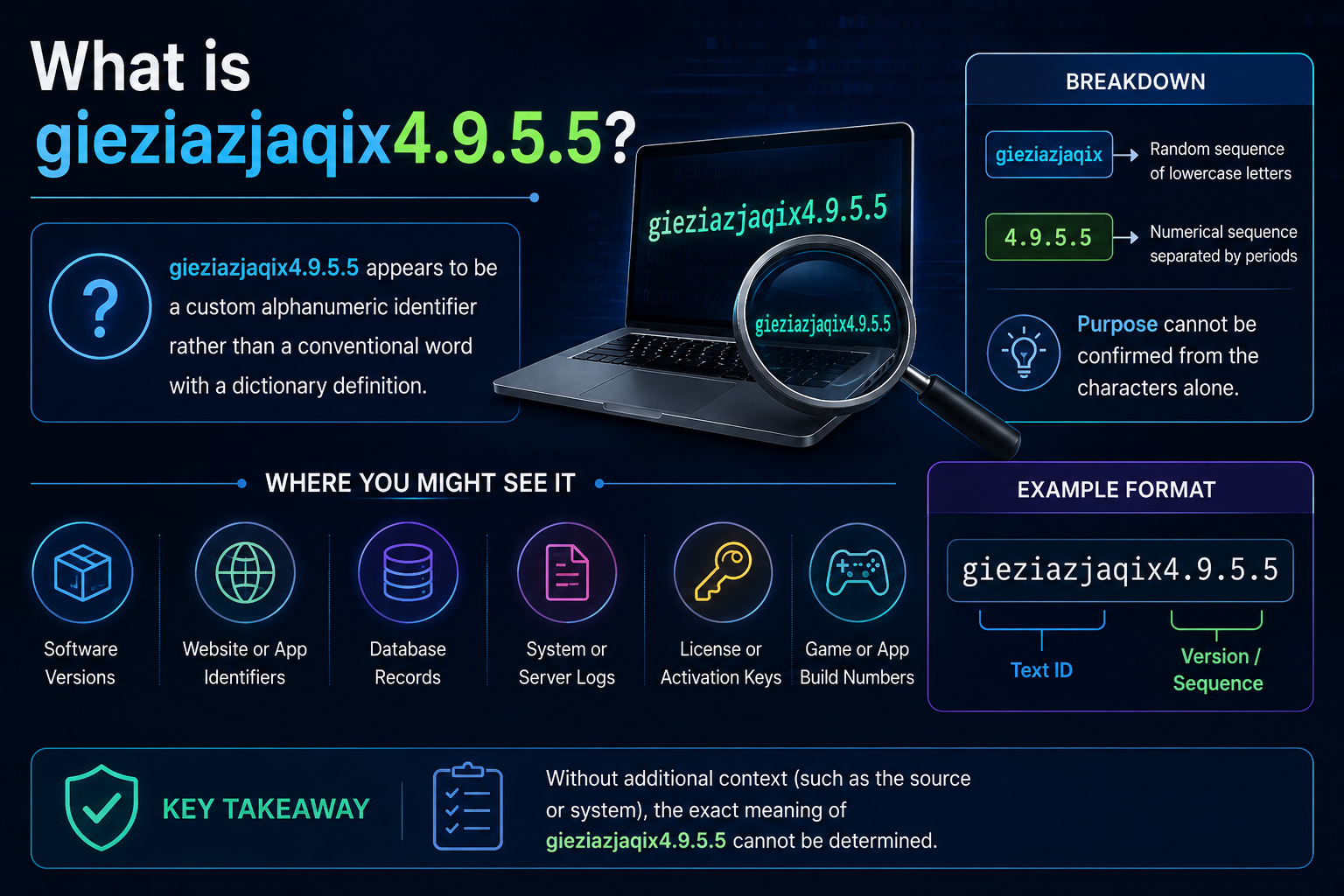
gieziazjaqix4.9.5.5 appears to be a custom alphanumeric identifier rather than a conventional word with a dictionary definition. The first section, “gieziazjaqix,” contains a sequence of lowercase letters that looks randomly generated, while “4.9.5.5” resembles a numerical sequence separated by periods. That combination can occur in many digital environments. For example, software packages may use numbers to represent releases, while websites and databases frequently attach unique strings to records. However, the exact purpose of this particular string cannot be confirmed from the characters alone.
Why Does gieziazjaqix4.9.5.5 Look Like a Version Number?
The 4.9.5.5 portion immediately attracts attention because periods are commonly used in software version numbers. A program might use a format such as 4.9.5 or 4.9.5.5 to distinguish one release from another. In some systems, each number represents a different level of development, such as major version, minor version, patch, and build. However, not every number separated by periods is a genuine software version. A website may simply generate identifiers using a similar pattern, so the appearance of a version number is a clue rather than proof.
Could It Be a Software Version?
It is possible that the numeric portion represents a software release, build, revision, or internal update. Software developers often use structured numbering because it makes different releases easier to identify. If gieziazjaqix is the name of a package, module, application, or internal component, then 4.9.5.5 could potentially identify a particular revision. Still, there is an important distinction between something that looks like a version and something that has been officially documented as one. Unless the string appears in release notes, official documentation, an application interface, or another reliable source, it should not automatically be described as a confirmed software version.
Could It Be a Username or Online Identifier?
Another possibility is that gieziazjaqix4.9.5.5 is an automatically generated username or digital identifier. Online services sometimes create unusual combinations of letters and numbers when users register accounts, when temporary profiles are created, or when systems assign unique names to records. The unusual letter sequence could make sense in that context because uniqueness is often more important than readability. If you encountered the term on a social platform, forum, gaming service, or profile page, examining the surrounding page would be more useful than trying to interpret the string as a normal word.
Could It Be a File, Build, or Internal Reference?
Digital systems use identifiers everywhere. A file, database entry, device configuration, software build, or automated process can receive a unique label that means very little to an ordinary reader but is useful to the system that created it. gieziazjaqix4.9.5.5 could therefore be an internal reference rather than something designed for public interpretation. This is especially relevant when the string appears inside a technical log, filename, URL parameter, dashboard, or error message. In such cases, the surrounding information usually provides the key to understanding its purpose.
Why Context Matters So Much
A strange string cannot be interpreted reliably in isolation. Imagine finding 4.9.5.5 inside a software settings page. You might reasonably suspect a version number. Find the same sequence inside a username field, however, and the interpretation changes completely. The same principle applies to the “gieziazjaqix” portion. A developer might use it as an internal project name, while a website could generate it as a unique identifier. Context transforms an apparently meaningless string into something understandable.
How to Investigate gieziazjaqix4.9.5.5
The safest approach is to look at exactly where the term appears. Start by checking the page title, nearby text, labels, and surrounding numbers. If it appears in an application, look for an “About,” “Version,” “Build,” or “System Information” section. If it appears on a website, inspect the page address and the text immediately around it. If it is inside a file or error message, note the file type and the application that produced it. These details can quickly narrow down whether you are dealing with a version, identifier, username, file label, or something else.
Search Engines Can Help, But Use Them Carefully
Searching for the exact phrase “gieziazjaqix4.9.5.5” may reveal useful clues if the string has been publicly indexed. Exact-match searching is particularly useful for unusual identifiers because common words can produce overwhelming results. If the phrase produces no meaningful results, that does not necessarily mean it is fake or meaningless. Private identifiers, temporary codes, internal references, and newly generated strings may never appear in search results. Search engines are useful evidence, but they should not be treated as proof of an identifier’s origin.
What the Letter Sequence Tells Us
The first part, gieziazjaqix, does not appear to follow a recognizable English word pattern. It contains repeated consonant and vowel combinations and has the appearance of a generated sequence. Such strings are common in automated systems because computers can create combinations that are unlikely to duplicate existing records. It could also be a deliberately chosen username or project label. Without a documented source, however, it would be misleading to claim that the letters have a specific hidden meaning.
What the Numbers May Represent
The 4.9.5.5 segment has several possible interpretations. It could be a software version, a build number, a revision sequence, a classification code, or simply part of a generated identifier. In technical environments, four-part version numbers are sometimes used when developers need to track more detailed releases. Yet there is no universal rule saying that four numerical segments must represent software. The surrounding application or website remains the deciding factor.
Is gieziazjaqix4.9.5.5 a Secret Code?
There is no reliable reason to assume that gieziazjaqix4.9.5.5 is a secret code. Unusual strings often look mysterious simply because they are not intended to be human-readable. A database identifier can appear just as strange as an encrypted value even when it contains no secret message at all. Before attempting to decode something, it is better to determine what type of system produced it. That simple step prevents a lot of unnecessary speculation.
Is It a Password or Security Key?
The string could theoretically be used as part of a credential or security-related value, but its visible structure alone does not establish that. If you found it in a password field, configuration file, authentication system, or security notice, treat it as potentially sensitive rather than experimenting with it publicly. Never publish private access codes, authentication tokens, recovery keys, or passwords simply because you want to identify them. Understanding an identifier should never come at the cost of exposing someone’s account security.
Could It Be Related to a Website?
Yes, unusual strings frequently appear on websites. They may be used in URLs, database records, tracking parameters, content IDs, temporary pages, or automatically created resources. A website might generate a unique identifier whenever a user submits a form or creates an account. If gieziazjaqix4.9.5.5 appeared as part of a web address, the complete URL and the page surrounding the identifier would be important clues. The string by itself is not enough to establish what the website uses it for.
Could It Be Malware?
An unfamiliar identifier should not automatically be labeled malware. Malware can contain random-looking filenames and strings, but ordinary applications also generate them constantly. Calling gieziazjaqix4.9.5.5 malicious without evidence would be inaccurate. If the term appeared in a security alert, suspicious file, unexpected browser extension, or unknown application, then the right response is to investigate the source, file location, digital signature, and security software findings rather than judging the string itself.
Why Random-Looking Identifiers Are Common
Modern digital services depend on identifiers because computers need reliable ways to distinguish one item from another. A database containing millions of users, products, files, posts, or transactions cannot rely entirely on human-readable names. Instead, systems often create unique strings automatically. This explains why people increasingly encounter combinations that look strange or meaningless. Something like gieziazjaqix4.9.5.5 may simply be a machine-friendly label created for a specific technical purpose.
How Developers Use Structured Identifiers
Developers may combine letters and numbers to create identifiers that communicate several pieces of information at once. A prefix can identify a project, while numerical sections can indicate a release, revision, or build. This approach can make troubleshooting easier because developers can identify exactly which component produced a particular record. However, naming conventions differ between organizations. One company’s 4.9.5.5 might represent a build, while another system might use the same format for an entirely different purpose.
What If You Found It in an Error Message?
If gieziazjaqix4.9.5.5 appeared in an error message, do not focus on the strange string alone. Read the complete message. Error messages often contain a component name, error code, timestamp, file location, or action that failed. Those surrounding details are far more informative. Searching the complete error phrase can also produce better results than searching the identifier by itself because other users may have encountered the same problem and documented a solution.
What If You Found It in a File Name?
A filename can contain almost anything, including automatically generated IDs. If you encounter this string in a file name, check the extension first. A document, image, executable, archive, or configuration file can each have completely different implications. Do not open an unknown executable simply to discover what it contains. If the file arrived unexpectedly, scan it with trusted security software and consider where it came from before interacting with it.
What If You Found It on Social Media?
If the string appeared on social media, it may be a username, profile identifier, post reference, or automatically generated account name. Avoid assuming that a strange handle proves anything about the person behind it. Usernames can be temporary, parody accounts can exist, and automated systems can create profiles for testing or other purposes. The most reliable information comes from the platform itself and from evidence that directly connects the identifier to a particular account.
Avoid Making Unsupported Claims
One of the biggest mistakes when researching unusual keywords is turning speculation into fact. If a search produces several unrelated descriptions, that does not establish a single meaning. Likewise, the presence of numbers that resemble a software version does not prove that the string belongs to a specific application. A trustworthy explanation should clearly separate what is known from what is merely possible. That approach is especially important when publishing information about obscure identifiers online.
Why Accuracy Matters for SEO Content
Search engines increasingly reward pages that genuinely answer a reader’s question instead of simply repeating a keyword. An article about gieziazjaqix4.9.5.5 should therefore provide useful context, explain the uncertainty, and help readers investigate the term themselves. Repeating the keyword dozens of times would add little value. A better page addresses likely search intent, explains possible meanings, provides practical verification steps, and avoids pretending to know information that cannot be confirmed.
A Simple Way to Think About the Term
Think of gieziazjaqix4.9.5.5 as a label rather than a word. A label does not necessarily have a dictionary definition. Its meaning comes from the system, website, application, or person that assigned it. This distinction makes the mystery much easier to understand. Instead of asking only “What does this word mean?”, ask “Where did this identifier come from, and what does that system use it to identify?” That is usually the more useful question.
Common Mistakes When Researching Strange Strings
People often make three mistakes when encountering unfamiliar identifiers. First, they assume every random-looking string has a hidden meaning. Second, they confuse a possible explanation with a confirmed fact. Third, they ignore the original source where the string appeared. All three can lead to inaccurate conclusions. The better approach is straightforward: preserve the original context, compare reliable sources, identify the system involved, and only then decide what the identifier represents.
Is There a Confirmed Meaning for gieziazjaqix4.9.5.5?
Based solely on the string itself, there is no reliable basis for assigning one confirmed meaning to gieziazjaqix4.9.5.5. Its structure suggests that it may be a generated identifier or version-style label, but that remains an interpretation rather than an established definition. Anyone claiming that it definitely belongs to a particular company, application, person, or technology would need supporting evidence. The responsible answer is therefore to describe the possibilities while making the limits of the available information clear.
Conclusion
gieziazjaqix4.9.5.5 is the kind of digital string that can look confusing until its context is understood. The combination of an unusual letter sequence and four numerical sections could represent a software build, generated identifier, account handle, file reference, database value, or another system-specific label. There is no need to invent a meaning simply because the string looks mysterious. Start with its source, examine the surrounding information, and verify any claims against reliable evidence. That method is more accurate, safer, and ultimately more useful than guessing.
FAQs About gieziazjaqix4.9.5.5
What is gieziazjaqix4.9.5.5?
gieziazjaqix4.9.5.5 appears to be an unusual alphanumeric identifier or version-style string. Its exact meaning cannot be confirmed without knowing where it was found or which system generated it.
Is gieziazjaqix4.9.5.5 a software version?
It may be a software version or build number because 4.9.5.5 resembles structured version numbering. However, the format alone does not prove that it represents a software release.
Is gieziazjaqix4.9.5.5 a username?
It could be a username or automatically generated online identifier. The unusual letters make that possible, but the original website or platform would need to be checked before making a definite identification.
Is gieziazjaqix4.9.5.5 dangerous?
There is no evidence from the string alone that it is dangerous. An unfamiliar identifier should not automatically be considered malware, a scam, or a security threat. Its source matters much more than its appearance.
Can gieziazjaqix4.9.5.5 be decoded?
There is no obvious standard decoding method based solely on the visible characters. Before attempting to decode it, identify whether it is actually an encoded value, a version number, a username, or simply a generated identifier.